Customer specification and functional specification in machine building, explained with an example.
The customer specification says what the plant must be able to do. The functional specification says how the supplier achieves it. Who writes what, when, and why in special machine building it is the gap between the two documents that costs money.
 Lukas EbermannCo-Founder & CTO8 min read
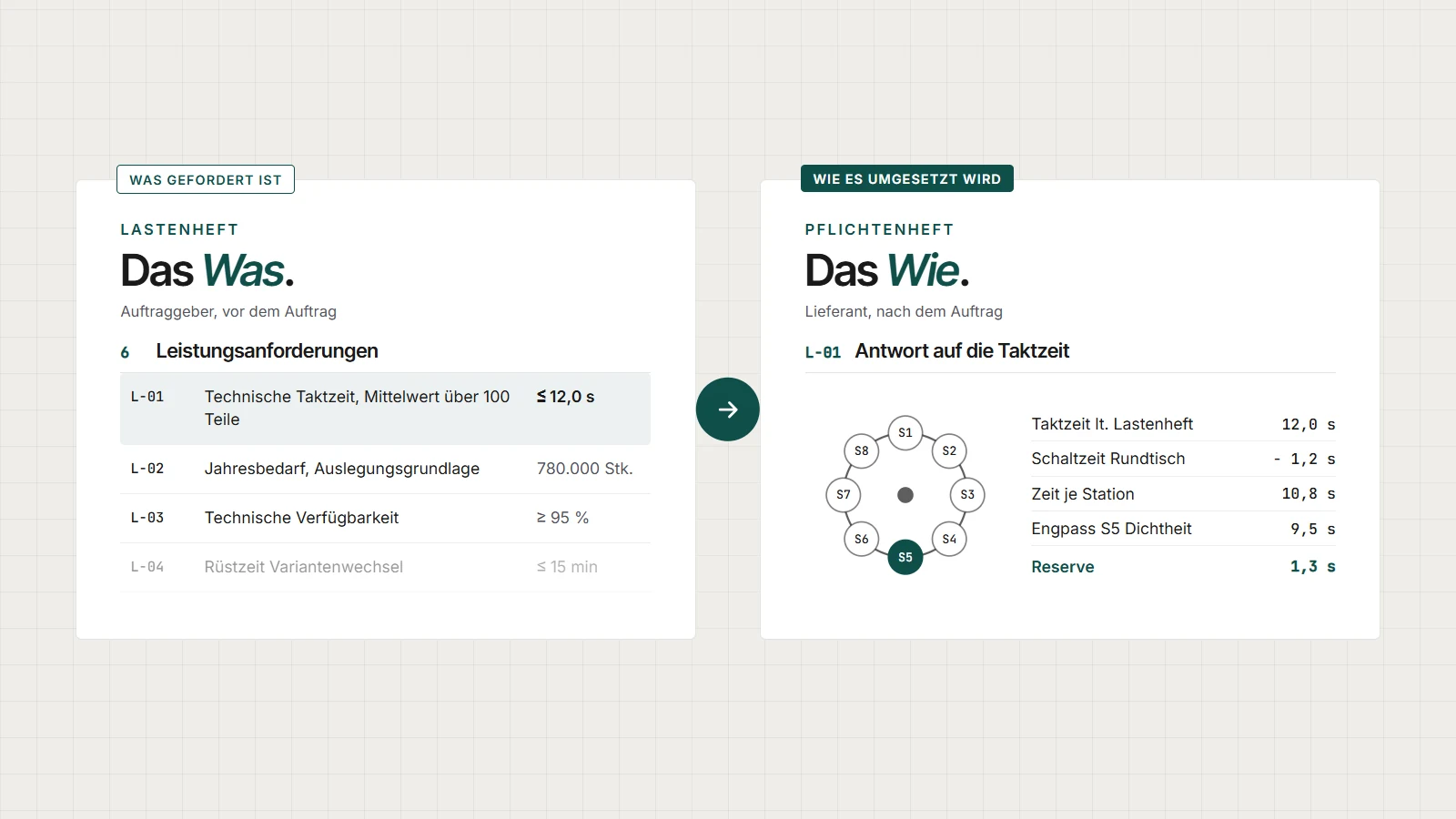
The customer specification describes what the customer requires of a machine: performance, quality, interfaces and acceptance. The functional specification describes how the supplier meets those requirements: plant concept, stations, components and calculations. The customer specification comes before the order, the functional specification after it. The customer approves it, and only then does detailed design begin.
Contents
- What is a customer specification, and what is a functional specification?
- The difference at a glance
- How a line in the customer specification becomes an answer in the functional specification
- Who writes what in special machine building?
- The process from customer specification to acceptance
- Where things go wrong between the two documents
- What this means for project management
- Further reading
In machine and plant engineering almost every project has two documents that sound similar and are often confused: the customer specification and the functional specification. Both describe the same machine. But they answer different questions, come from different sides and are written at different times. This article shows the difference with one example that runs all the way through, and explains where things go wrong between the two documents in practice.
What is a customer specification, and what is a functional specification?
The customer specification is the customer's description of requirements. It records what a machine or plant has to achieve and under what conditions it will be operated: cycle time, quantities, variants, quality limits, interfaces, installation conditions, safety, documentation and acceptance. How the supplier achieves this is not in it.
The functional specification is the supplier's answer. It describes how the requirements from the customer specification are met: plant concept, stations, components, control architecture, cycle time calculation and the evidence with which each requirement is verified at acceptance.
Both terms are defined in DIN 69901-5, which sets out the terms used in project management. For automation projects, VDI 2519 describes how to draw up both documents. In German the two documents are called Lastenheft and Pflichtenheft. In English the Lastenheft is usually called a requirements specification, the Pflichtenheft a functional specification. This article uses customer specification for the Lastenheft.
In short, the customer specification asks what, and the functional specification answers how.
The difference at a glance
| Customer specification | Functional specification | |
|---|---|---|
| Author | The customer, in special machine building often together with the supplier's sales team | The supplier, usually project management and design engineering |
| Question | What does the plant have to achieve? | How does the plant achieve it? |
| Timing | Before the order, several revisions until the purchase order | After the order, before detailed design |
| Content | Requirements with value and verification | Solution, components, calculations, test plan |
| Level of detail | Concrete enough that every requirement can be checked | Concrete enough that design can work from it |
| Approval | Becomes binding with the purchase order | Is approved by the customer |
| Typical mistake | Commitments are in emails instead of in the document | The customer specification is copied instead of answered |
How a line in the customer specification becomes an answer in the functional specification
The difference is clearest with a single requirement. The following example comes from our example requirements specification for an assembly and test cell, a fictitious cell for thermostatic valve bodies.
Under the performance requirements, the customer specification says:
L-01 Technical cycle time (machine cycle, mean over 100 parts, without operator waiting time): ≤ 12.0 s. Verification: time measurement at FAT and SAT. Priority: must.
That is a good line in a customer specification. It says what is required, how it is measured and that acceptance depends on it. It says nothing about the solution.
The functional specification has to give an answer to it that can be recalculated. For example:
- Rotary indexing table with 8 stations, indexing time 1.2 s, which leaves 10.8 s processing time per station
- The longest operation is the leak test at station S5 with an 8.5 s test cycle, plus about 1 s for moving the test adapter in and lifting it off
- That leaves a reserve of just over 1 s at S5, and all other stations are well below
- Verification as required, by cycle time measurement at the factory acceptance test (FAT) and the final acceptance (SAT)
Only this answer makes it possible to check whether the requirement can be met. It also shows where things get tight. Had sales promised the customer 10.5 s, only 9.3 s would remain at S5. After subtracting the time to move the adapter in, that is no longer enough for the test cycle. The functional specification would then need a second test station and a larger rotary table. In the example, however, this very commitment is not in the customer specification. It is only in an email.
Who writes what in special machine building?
In the textbook version the roles are clear. The customer writes the customer specification, the supplier writes the functional specification. In special machine building and plant engineering it usually works differently.
The customer specification grows with the quotation. The customer brings a first version, often with gaps. The supplier's sales team asks questions, calculates and suggests alternatives. Over several revisions the customer specification grows until price and performance fit together and the order is placed. Part of what is agreed along the way ends up in the document. Another part stays in emails, meeting notes and phone calls.
Someone else writes the functional specification. After the order, project management takes over. Together with design engineering it writes the functional specification, based on the customer specification that was ordered. Project management often does not know what is only in the sales correspondence. A separate article shows how to catch this at the project handover in plant engineering.
Approval is the threshold. The customer checks the functional specification and approves it. From then on, design works to the functional specification. Whatever has not been noticed by this point usually only comes to light at acceptance, and by then it is expensive.
The process from customer specification to acceptance
- Customer specification: The customer describes the requirements, often together with the supplier's sales team.
- Quotation and clarification: The supplier submits a quotation, open issues are clarified, and the customer specification gets new revisions.
- Purchase order: A particular revision of the customer specification becomes part of the contract.
- Functional specification: The supplier describes its solution and answers every requirement.
- Approval: The customer checks the functional specification and approves it.
- Design and build: The plant is built to the approved functional specification.
- Acceptance: At FAT and SAT the plant is checked against the requirements of the customer specification, using the evidence from the functional specification.
Where things go wrong between the two documents
The customer specification is copied instead of answered. A functional specification that only repeats the requirements in its own words is not a functional specification. Every requirement needs a solution and a means of verification.
Deviations are not marked. If the supplier cannot meet a requirement, or can only meet it differently, that belongs explicitly in the functional specification, with the reasons. If it is only between the lines, the customer specification still applies as far as the customer is concerned.
Commitments outside the customer specification are missing. This is the most expensive case, because nobody sees it. The functional specification answers every line of the customer specification properly, just not the cycle time from the email or the variant from the meeting note. In the example requirements specification there are three such commitments, each with its consequences.
Changes after approval run on the side. If something changes after approval, it belongs in a new revision and, if price or schedule are affected, in a change order, which is the supplier's claim for the additional work. Otherwise the documents no longer match the plant at acceptance.
A simple remedy for the first two mistakes is a cross-reference table in the functional specification. It has one row for every requirement ID from the customer specification, next to it the chapter in the functional specification and a status of met, deviating or open. It only helps against the third mistake if someone has gone through the correspondence from the quotation phase beforehand.
What this means for project management
Whoever writes a functional specification needs more than the ordered revision of the customer specification. They need the earlier versions, the emails with the customer and the notes from the clarification meetings. In practice hardly anyone reads all of that, because nobody has the time to work through three months of coordination.
This is where KoAssist comes in. It reads the customer specification, revisions, emails and minutes of a project and answers a question such as "What did we commit to the customer on cycle time?" with the place where it is written: document, email or note. That way a commitment comes to light before it should have gone into the functional specification, and not only at acceptance.
Further reading
- Requirements specification in machine and plant engineering: example and template: the complete example specification with all 14 sections and a Word template to download.
- The requirements list in design engineering: how the customer specification becomes a quantified working basis with demands and wishes.
- Onboarding and knowledge retention in design engineering: why project knowledge sits in emails and people's heads, and how to make it easy to find.

Frequently asked questions
More from the blog
Back to overview- 15 November 2026Article5 min
Can ChatGPT analyse a customer specification?
An 80-page customer specification, and the quotation has to go out by Friday. What ChatGPT does well in the analysis, where it reaches its limits and what to settle before a customer specification ends up in a chat window.
5 min - 15 November 2026Article4 min
Backing change orders in plant engineering: how additional work from customer changes gets paid
Customer changes create additional work, and it only gets paid when it is backed by evidence. What a change order in plant engineering needs, when to submit it and which documents make the difference at the final invoice.
4 min - 15 November 2026Article4 min
How much time does coordination cost in design engineering?
Collecting status, answering questions, preparing status meetings: in design departments, coordination takes up many hours a week. Two cases from special-purpose machine building and a simple method for measuring your own effort.
4 min