The requirements list in design engineering, with an example from machine building.
The requirements list turns the customer specification into demands and wishes that design engineering can work from. How it is structured, how the requirements analysis works and where gaps appear in practice.
 Lukas EbermannCo-Founder & CTO9 min read
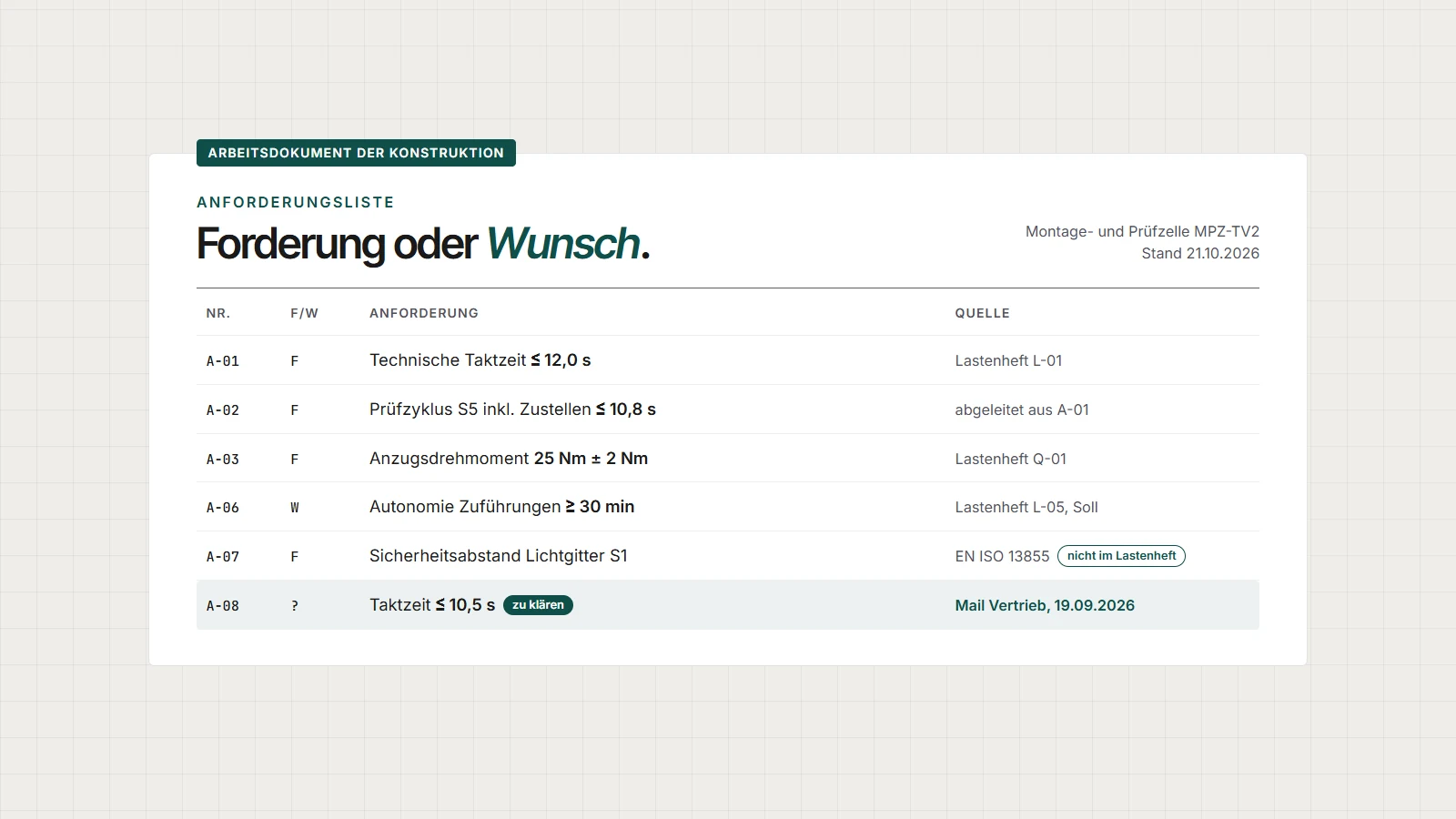
The requirements list is the working document of design engineering. It collects all requirements for a product, from the customer specification, standards and in-house rules, and divides them into demands and wishes. Each requirement gets a value, a source and the date of its last change. It is created in the requirements analysis and kept up to date until acceptance.
Contents
Between the customer specification and the first sketch there is a step in design engineering that is often skipped: the requirements list. It is not another document for the customer but the tool with which design engineering clarifies what it is actually supposed to build. This article shows how a requirements list is structured, how to fill it in the requirements analysis and what it looks like in a concrete example.
What is a requirements list?
The requirements list is an ordered compilation of all requirements for a product, a machine or a plant. In systematic design according to VDI 2221 it comes at the end of the first phase, clarifying and defining the task. The search for solutions only begins once it is in place.
Each row of the list contains one requirement, with a numerical value where possible, and a classification. Is it a demand that must be met, or a wish that should be met if the effort allows? It also records the source of the requirement and the date on which it was last changed.
That is what sets a requirements list apart from a collection of notes. It can be checked: at the end, every row can be ticked off or not.
Requirements list, customer specification and functional specification
The three documents are often mentioned in the same breath, but they have different jobs.
| Customer specification | Requirements list | Functional specification | |
|---|---|---|---|
| Author | Customer | Supplier's design engineering or project management | Supplier |
| Purpose | states what is required | turns it into a complete, quantified basis for the work | states what the solution looks like |
| Sources | customer's needs | specification, standards, laws, manufacturing, internal standards, agreements | requirements list and solution concept |
| Readers | suppliers at quotation stage | your own team | customer, for approval |
| Lifetime | until the order, then through revisions | kept up to date until acceptance | applies from approval |
The most important difference is in the Sources row. The customer specification contains only what the customer considers necessary. Design engineering needs more: the standards that apply to the machine, the conditions of your own manufacturing and assembly, the experience from earlier projects. The requirements list is where all of that comes together.
In many companies the line is blurred. Some call the customer specification itself the requirements list, others keep the requirements list as an annex to the functional specification. How the customer specification and functional specification work together is shown in a separate article.
How is a requirements list structured?
There is no binding format. A table with these columns has proved itself:
- No.: a unique identifier, so that meetings, emails and the functional specification can refer to the row.
- D or W: demand or wish.
- Requirement: what is required, as concretely as possible, with value and unit.
- Source: where the requirement comes from, for example the specification with chapter, a standard, a call note or an email with its date.
- Verification: how it is checked whether the requirement is met.
- Last changed: date of the last change, so that it stays visible what is new.
For demands it pays to distinguish more precisely. A fixed demand has exactly one value, for example a DN15 connection. A minimum or maximum demand sets a limit, for example a cycle time of no more than 12 s. A range demand specifies a value with a tolerance, for example a tightening torque of 25 Nm ± 2 Nm.
Wishes should also be weighted. Later they decide which of several acceptable solutions is the better one. In practice a wish without a weighting is usually dropped without anyone saying so.
An example from an assembly and test cell
The example builds on our example requirements specification for machine building, a fictitious assembly and test cell for thermostatic valve bodies. Design engineering takes over the requirements from the specification and adds what it needs on top. An extract, without the Last changed column:
| No. | D/W | Requirement | Source | Verification |
|---|---|---|---|---|
| A‑01 | D | Technical cycle time ≤ 12.0 s, mean over 100 parts | Specification L-01 | Time measurement at FAT and SAT |
| A‑02 | D | Leak test cycle at S5 incl. infeed ≤ 10.8 s | derived from A‑01 with 1.2 s indexing time | Time measurement at S5 |
| A‑03 | D | Tightening torque of valve insert 25 Nm ± 2 Nm, angle of rotation monitored | Specification Q-01 | Screwdriving data for each part |
| A‑04 | D | Leak rate ≤ 0.5 cm³/min at 6 bar | Specification Q-02 | OK and NOK master parts |
| A‑05 | D | Changeover time for a variant change ≤ 15 min, without tools | Specification L-04 | Demonstration at FAT |
| A‑06 | W (high) | Autonomy of the feeders ≥ 30 min | Specification L-05, there as Should | Measurement at FAT |
| A‑07 | D | Safety distance of the light curtain at S1 according to EN ISO 13855 | Standard, not in the specification | Calculation, safety acceptance |
| A‑08 | ? | Cycle time ≤ 10.5 s | Email from sales to customer, 19 Sep 2026 | open, to be clarified |
The extract shows three things.
Must and Should become demand and wish. The specification marks L-05 as Should. In the requirements list it becomes a weighted wish. It feeds into the evaluation of the concepts but is not a knockout criterion.
Derived requirements are added. A-02 is not in the specification. It follows from A-01: with a rotary indexing table and an indexing time of 1.2 s, 10.8 s remain at each station. That is exactly the figure the design of the test station needs, not the 12 s from the specification. The same goes for A-07, which comes from the standard and which the customer rightly does not write down separately.
Agreements outside the specification belong in the list, visibly. A-08 is the most delicate item. Sales gave the customer 10.5 s by email, while the ordered specification says 12.0 s. The requirements list is the place where such a contradiction has to show up, with its source and the status "to be clarified". At 10.5 s only 9.3 s would remain at S5, and that is not enough for the test cycle. If this is only noticed at acceptance, it gets expensive.
How the list is built in the requirements analysis
The requirements analysis is the step in which the requirements list is filled. Five steps have proved themselves.
- Collect the sources. The customer specification in its valid revision with all annexes, earlier versions, call notes and emails from the quotation phase, the applicable standards and directives, internal design guidelines.
- Extract the requirements. Every statement that requires something becomes a row of its own. Phrases such as "robust design" stay in the list as open rows for now.
- Quantify. Where possible, every requirement gets a value, a unit and a measurement method. "Short changeover time" cannot be checked, "≤ 15 min, without tools" can.
- Check for gaps and contradictions. A checklist of main headings helps to make sure nothing is forgotten: geometry, kinematics, forces, energy, material, signals, safety, ergonomics, manufacturing, quality control, assembly, transport, operation, maintenance, recycling, costs and schedule. Contradictions between sources are marked as open issues, not quietly resolved.
- Clarify and release. Open issues go to the customer or to the team as a list of questions. Only then is the list released as the basis for the concept phase.
How to work through an extensive specification systematically for step 2 is shown in the article on analysing customer specifications.
Common mistakes
The list is written once and then forgotten. Requirements change after the order: new variants, changed interfaces, findings from the design work. If they do not go into the list, acceptance is checked against a status that nobody knows any more.
Requirements without a source. If a row does not say where it comes from, nobody can tell after a change whether it still applies. The source is also the quickest argument in a discussion with the customer.
Solutions instead of requirements. "Servo press 5 kN" is already a solution. The requirement behind it reads something like "press-fit force up to 3.5 kN, force and stroke documented for each part". Writing solutions into the requirements list cuts off alternatives before they have been examined.
The customer specification as the only source. What sales promised on the phone or by email is often not in the specification. If you derive the requirements list from the ordered document alone, you take over its gaps.
What this means for design engineering
A good requirements list is only as complete as the sources that went into the requirements analysis. The customer specification and the standards are quickly to hand. The difficult part is the emails, minutes and notes from the quotation phase, spread across inboxes and project folders.
This is where KoAssist helps. It reads the specification, revisions, emails and minutes of a project and answers questions such as "Which cycle time did we give the customer?" with the place where it is written. Every answer refers to file, page and section. That way a commitment like A-08 ends up in the requirements list before design begins, and not only in the acceptance report.
Further reading
- Customer specification in machine and plant engineering: example and template: the complete sample specification the example comes from, with a Word template to download.
- Customer specification and functional specification in machine building: who writes what and when, and where the gap between the two documents costs money.

Frequently asked questions
More from the blog
Back to overview- 15 November 2026Article5 min
Can ChatGPT analyse a customer specification?
An 80-page customer specification, and the quotation has to go out by Friday. What ChatGPT does well in the analysis, where it reaches its limits and what to settle before a customer specification ends up in a chat window.
5 min - 15 November 2026Article4 min
Backing change orders in plant engineering: how additional work from customer changes gets paid
Customer changes create additional work, and it only gets paid when it is backed by evidence. What a change order in plant engineering needs, when to submit it and which documents make the difference at the final invoice.
4 min - 15 November 2026Article4 min
How much time does coordination cost in design engineering?
Collecting status, answering questions, preparing status meetings: in design departments, coordination takes up many hours a week. Two cases from special-purpose machine building and a simple method for measuring your own effort.
4 min